Showing posts with label Book Reviews. Show all posts

Saturday, September 25, 2010

A Godless Game Theory

In “The God Delusion”, Richard Dawkins argues that morality does not originate from religion. According to him, people do not need an omnipotent omniscient entity to stop them from turning into wild nasty beasts. To justify his view, Dawkins uses a Darwinian perspective to argue that morality originates from the evolution of altruistic genes that eventually serve the purpose of preserving one’s kind. When put that way, it really doesn’t sound all that altruistic. But Dawkins does manage to build a solid argument backing his theory. You’d have to read the entire chapter, though, to be more or less convinced.
Anyways, I can think of another field that might come in handy in explaining why the lack of belief in a supernatural power overseeing every movement and every thought does not necessarily equate primitive immoral behavior: Economics. As unlikely as it might first seem, I think that the concept of “Game Theory” provides an excellent explanation. Game theory is a mathematical tool applied in business economics to study the interaction of a number of firms in different situations. The theory basically concludes that firms who know that they are likely to interact frequently with each other on the long run tend to be more cooperative rather than aggressive towards each other.
On a personal level, if you know you’re going to be seeing your neighbor, for example, for a number of years to come, you’re more likely to act politely towards them. You know it’d make your life miserable to do otherwise. The same idea applies to wider circles. When a person earns a reputation in a community for being particularly nasty, it really just makes everything more complicated for that person. Ergo, no matter what you believe -or don't believe- in, living a decent moral life is pretty much the way to go.

Wednesday, July 29, 2009

Hot Property!

Corporate espionage, secret agents, and conspiracy schemes are all part of Pat Choate’s book “Hot Property, The Stealing of Ideas in an Age of Globalization”. In his Hollywood-movie-like account, he talks about what he sees as the main challenges facing intellectual property (to be more specific American intellectual property) at a time when other nations are “secretly conspiring in the dark to snatch those brilliant ideas while smoking on their thick fat cigars in the backroom of some family-owned restaurant”. Ok, he doesn’t literally say that. It’s just the mental image he gives you. Of course, piracy and counterfeiting are serious problems that pretty much every country suffers from. But Choate jumps to conclusions on how “evil” Germany, Japan, and China resorted to tactics aimed at strengthening their economies using American patented innovations. He recounts one example after another of how countries have stolen one brilliant idea after another from naïve American inventors earlier in the 20th century. However, he conveniently neglects to mention that the budding American nation in its early years chose no to respect foreign intellectual property and continuously infringed it until its national economy and industry were strong enough. This seems to be the case with many emerging economies. You can’t just single out Germany, Japan, or China, who are today among the main contributors to innovation patents. In general, Choate fails to make a solid case as he seems to have sacrificed depth and quality for the sake of quantity.
Final verdict: Not Hot.

Wednesday, June 17, 2009

The Reader

Brilliant! That’s how I would describe “The Reader” in one word. The novel written by Bernhard Schlink is one of the deepest most moving books I have read in a while. It’s one of those stories that don’t just end after you turn the last page. But the disturbing events and questions haunt you and keep you thinking.
The story starts with the relationship between a fifteen-year old teenager, Michael, with an older Hanna (who in today’s Hollywood flashy terms would be called a cougar). The relationship is further complicated by power struggles, crippling dependence, and betrayals. However, their relationship is beyond naïve distinctions of right and wrong. In a sense, it transcends the average mundane love story in a tradition that is reminiscent of Milan Kundera's "The Unbearable Lightness of Being".
Throughout the next chapter we learn about Hanna’s past work in a concentration camp. Ironically, Michael is involved in the court that is supposed to condemn Hanna. The story audaciously humanizes those who have been readily labeled as “villains”. But at the same time, it does not fully exempt Hanna of the guilt and responsibility of what she had committed. Every detail about her character adds complexity and depth. For example, her passion for fine literature in the midst of the horrors of the concentration camp gives her both a humane and a villainous dimension. While the Holocaust is at the center of the novel, it doesn’t stop at that. The questions raised are universal questions on morality, love, and perceptions. The main characters are confused and complex. They are struggling to understand others and themselves, which makes any reader relate to them even if they haven’t been through the horrors, suffering, guilt and shame associated with the Holocaust. Simply put, this is not your average mopey Holocaust story as I first thought. It is deeper. It is more comprehensive. It is brilliant!

Saturday, June 13, 2009

The Reluctant Fundamentalist

Ah, finally I’m done with the longest short novel ever! For some reason the 200-page novel entitled “The Reluctant Fundamentalist” seemed to infinitely drag on. Even though, Hamid has a good story to tell, something about a “conversation” in a monologue style seriously turned me off.
The story starts when Changez, a Pakistani from Lahore who studied and worked in the US, presumably accidentally meets a presumably American “tourist”. Changez invites the man for a cup of tea, and almost immediately spills his story about his experience in the US including some really personal details. Although grabbing random tourists and rambling on about my life, isn’t exactly my style, I continued reading the story hoping that something will actually happen. I was disappointed. All the main events happen in retrospect. Their truth and accuracy are even questioned at one point in the story. So, instead of traveling back in time with Changez and feeling involved in the story, I found myself sitting in a café with a chatty Pakistani and a suspiciously anxious American. Although, logically I should identify with Changez, I really felt more for the poor trapped “tourist” who had to sit for the whole evening listening to some guy ramble about a girl he almost had and a brilliant future he almost had. Sorry, but this one-sided conversation only reminded me of those abhorred Eid visits I had to sit through as a child to greet the older members of our extended family.
To be fair, Hamid raises some very good points about alienation, not just post 9/11, but about life in general. Most characters of the novel seemed to me like individual islands, each floating in his/her own direction. Of course, there is also the brilliant comparison between the harsh world of business and that of religious extremists. My guess is that the novel was short-listed for a Booker Prize for the ideas it raises. But apart from that, neither technique nor language really grabbed me.
Anyway, I see that Hamid has another novel entitled “Moth Smoke” about a fallen man from Lahore in an impossible relationship . Mmm, sounds a little familiar. Should I give it a try? Nope. Next, please.

Saturday, February 14, 2009

The First Century after Beatrice

Amin Malouf writes in his novel The First Century after Beatrice about a disaster that plagues humanity, and sends different ethnic groups adrift. To digress a little before I start my review, I cannot but marvel at the fact that Malouf wrote his novel originally in French, I read it in Arabic, and now I’m writing a review of it in English. So even if some rift tears humanity apart, I believe that we can always count on literature to help bridge the gap.
Now back to the novel. The catalyst in this story is a tiny bean sold on the streets of Cairo as a magical cure from bearing female daughters. A visiting French entomologist stumbles upon the beans and decides to keep some as a souvenir. However, this ill-fated souvenir leads to the discovery of an epidemic that will soon teach humanity the importance of the natural balance between genders.
Apart from the obvious theme of sexism, Malouf also tackles a variety of other controversial issues ranging from racism, international development, to population control. The issue of population control is particularly relevant today which is why the BBC recently published an article on the subject under the title “Population: The elephant in the room”. What is notable, as well, is that Malouf divides the world into mainly North vs. South, as opposed to the traditional West vs. East, which is probably a bit more accurate.
Personally, I truly appreciated Malouf’s ability to incorporate very interesting and relevant ideas in an enjoyable and believable memoir. The novel, however, takes a more apocalyptic tone as we approach the end, echoing the looming gloomy end of humanity. It also adopts the style of a preachy lecture, which inadvertently but inevitably affected my ability to enjoy the novel as a novel. So overall, I’d give it a 3.5 out of 5.

Monday, February 2, 2009

I Think of You

The collection of short stories entitled I Think of You by the Egyptian-born and Booker-shortlisted writer Ahdaf Soueif is simply one of the best pieces of literature I have read in a while. Soueif’s prose flows beautifully and smoothly just like a poem while maintaining a direct conversation-like connection with the reader. Using that magical combination, the author weaves together a collection of short stories that centers around a number of women struggling with a variety of issues including culture clash, displacement, marriage, families, career, and other themes that are very relevant to our world today. The events in the story mostly take place either under the clear sun of Egypt of under the rainy clouds of England; thus, creating a perfect bipolar medium for contradictions and disorientation.
Even though I truly enjoyed this book and can’t wait to get hold of other stories by Soueif, I have to admit that oftentimes the book was confusing. The first two stories led me to think that the whole book was a number of short stories narrating different periods in the life of a main character named Aisha. However, somewhere in the third story – if I’m not mistaken, I discover that the character’s name suddenly becomes Asia while still retaining striking similarities to the first character. It eventually turns out that there are a number of female characters in the book all leading very similar yet very different lives. Now that I’m mentioning it, I can’t help but think that the book also strikes some resemblance to the author’s life. So a major part of it could be biographical as well.
Anyways, as long as you keep in mind that there is a number of main characters in the book, not just one, the stories will be much more enjoyable and less confusing. So don’t let that dissuade you from enjoying Soueif’s brilliant stories.

Tuesday, January 20, 2009

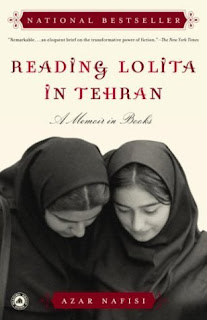
Reading "Reading Lolita in Tehran" in Doha

I acquired my copy of the novel Reading Lolita in Tehran by Azar Nafisi in Doha, and read it here. This made it possible for an interesting comparison between two conservative self-proclaimed Muslim societies, one is the Islamic Republic of Iran and the second is the State of Qatar – notice that as much as Qatar is committed to its Islamic heritage, the official name of the country does not mention any reference to religion.
Even though it is quite tempting to discuss Nafisi’s literary approach and tools, I am going to focus in this post mainly on how both societies differ from each other and the ramifications of such difference on Nafisi’s work.
Nafisi describes her country, Iran, as a paradise that was turned into a living hell ever since Islamic laws were implemented. Music and Western literature are banned, strict dress codes are enforced, and arbitrary curfews are imposed, to name just a few of the restrictions Nafisi and her students suffered from. Qatar, on the other hand, reached some type of a compromise that allows in the luxury of Western lifestyle while still preserving its Islamic identity and values. Conservative values of this society are evident in the way most citizens adhere to national dress, although oftentimes worn as a sign of cultural pride rather than religious obligation. Incoming residents and tourists are also expected to dress and behave in a modest way in public. But, again, imported international goods in the form of literature, music, clothing, etc are widely distributed and are part of everyday life.
Apart from the different approach to “Islamic laws” in both countries, there is also the obvious fact that the majority of the population in each country belong to a different sect of Islam. But I won’t delve much into that to avoid igniting any sectarian prejudice.
So which one is the real representation of Islamic society? The smarter question would actually be "is there only one version of how Islamic societies are supposed to be"? Even though many would claim otherwise, but really no one has the authority to decide.
This leads me to my main problem with Nafisi’s novel where she regards the actions of the Iranian government as the sole true manifestation of Islam. Therefore, founds her novel on the idea of lashing both institutions with ruthless criticism. I understand that she is deeply frustrated. However, this shouldn’t turn into a mental blind spot against other possibilities within Islamic societies, as my example shows.
To be honest, I was quite disappointed as I expected a scholar and professor like Nafisi to have sharper abilities in distinguishing between a theory and its varied implementations in real life.

Monday, December 29, 2008

The Book of Saladin

As the introduction states, The Book of Saladin is a work of fiction based on historical figures and events. The novel takes place in medieval times with Saladin, the legendary Kurdish leader, as the main character alongside many other characters who once existed outside the pages of this novel. However, the intimate and intricate details of characters’ lives as described in the novel are weaved from the imagination of the author, Tariq Ali.
The genre of fictional history can be quite problematic especially when you choose to write a fictional biography of a character much revered in the Muslim world. For many readers, this could be the only encounter they ever have of this figure; thus, the hazy line between fact and fiction slowly fades somewhere in the back of a dusty memory. My concern in not only for the average reader, but also for the implications of vagueness that is created. Historic characters like Saladin have had far-reaching effects on the collective Muslim conscience. So when such perspective is tampered with, expect nothing but to unleash a wave of unease and turmoil.

The image that probably best describes this attempt at rewriting history is that of a fine piece of classical art marred by amateur graffiti. The aim of the author is probably to bring this larger-than-life figure closer to the modern reader. But there is a vast difference between humanizing a character by describing their pains and joys, and by incessantly demeaning them with trivial affairs. Ali could have done a much better job in bringing Saladin back to life as a person rather than a legend without plunging so low as to mention lengthy detailed accounts of tricks and rituals of eunuchs and the harem.
These mundane side stories do not add much to the plot but they do serve another purpose. They also create a shock factor when these images clash with the traditional view of Islam. It is quite obvious that Ali wants to shatter that uptight conservative image in favor of a much more liberal one, an image where Muslims and Jews coexist amicably, and wine and physical pleasures are applauded not frowned upon. I do not have a problem with that. Islam is open to a wide range of interpretations ranging between both extremes. But if you’re an author and you want to offer your own view, do that using your own fictional characters interacting with each other in your own setting. Please do not use legendary characters, whose actions have had long-lasting consequences, as your mouthpiece. So Mr. Ali, the next time your brush is itching for some graffiti, may I offer you a blank sheet of paper?